
On New Year's Eve, 2017, I flew to Vietnam. People ask me, why Vietnam?
It was a swell time, and it's where I bought my favorite mug.

A question for the ages
Tim and Janet just moved there again in the fall. They'll be there for two semesters to teach and reconnect with old friends. I've always wanted to revisit Vietnam. If I did so with Tim and Janet there, I could benefit directly from their local knowledge. It's also an opportunity to be a more independent world traveler with the benefit of more life experience and self-worth.
So I flew to Đà Nẵng through EVA Airways with my little brother Ian. We would meet up with our family, who put us up in our own individual studio apartments for 9 days from December 30 to January 8. I could chronicle each day, but it seemed less boring to me if I centered my writing around themes instead. Feel free to skim, read selectively, or read from front to back like a book.
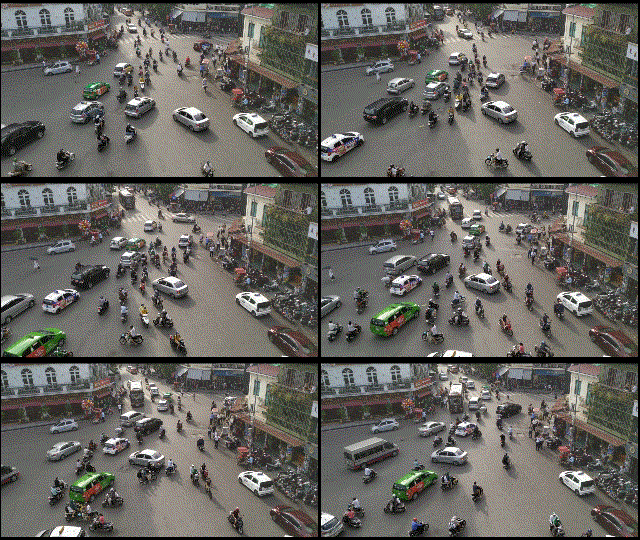
Where the USA has car culture, Vietnam has motorbike culture. Google Maps gives different navigation results for two-wheelers, who can more easily navigate some of Vietnam's more narrow roads or alleyways. On the major roads, driving in Vietnam looks kind of like this:
not my image
"Right of way" doesn't seem to be a concept here. Note: no left turn light to help make clearance for the car from the lower right. Note, also, that he'll make his own damn clearance, thank you very much. Note the motorbikes, comprising most of Vietnam traffic, making way for him as he does so. At first it looked completely lawless and perilous to me, but the longer you spend in traffic, the more you understand its tacit logic and unwritten norms. If I'm a sedan driver in Vietnam, I know that motorbikes can nimbly swerve around me as I slowly U-turn out of a parking spot on an arterial road. And if I'm a motorbike driver, I know that I can squeeze into the two spare feet between an 18-wheeler and the curb, but if that truck starts to drift right, I need to be ready to slow down or pull onto the pavement. I'd call the system "intuitive," not in the sense that it's easy to pick up, but in the sense that it is driven more by pragmatic goals and opportunities more than by precautionary rules and formal systems. Crossing lights and protected turns exist, but only at intersections of multi-lane major arterial roads.
Crossing through traffic as a pedestrian is similarly "intuitive" and terrifying for foreigners:

not my image
The way it was described to me, the proper technique for crossing the street in Vietnam sounded like a complete leap of faith: just start walking through traffic, at a steady and predictable pace, and the traffic will anticipate your future position and swerve or slow around you as appropriate. It does seem like a leap of faith until you put yourself in the mindset of the Vietnamese driver, where the entire driving experience is squeezing into gaps and dodging obstacles. Once I rode on the back of enough motorbikes to internalize that drivers are operating by the same expectations I was while speedwalking between classes in high school, I realized that I like crossing streets in Vietnam better than I like crossing streets in America.
Here's how it works: I pick a place to cross where I can be seen in both directions for some distance. Maybe it's at a crosswalk, or maybe it's just in the middle of the street. I look both ways for vehicles. If all I see for a while is motorbikes, I know that my crossing will not get in their way, so I start walking at a predictable pace. If the motorbikes are far away from me, like a couple seconds, I will walk at a moderate to brisk pace. If the motorbikes are very close, though, I walk at a slow pace, so that more motorbikes have more lead time, and fewer motorbikes have dangerously little lead time. I don't stop, and I certainly don't speed up, but I might slow down a bit if I'm not sure that a motorbike who's about to cross my trajectory is going to make enough distance between themself and me. Now, if there's large vehicles coming, and traffic is flowing fast and consistently, I want to wait for that car to pass, or otherwise time my crossing so that I will be far away from the car when it passes through my trajectory.
I think I don't always feel comfortable exercising the privilege of "right of way" as a pedestrian in America; the thought of getting in people's way terrifies me. (A lifelong theme.) I hate the thought that, for example, the time I was crossing through a lane might have been the only time in a long time that someone could have turned left into that lane, and I added 90 seconds of frustrated waiting to their trip. In Vietnam, I'm not worried about this at all, because that person trying to turn left is probably already 70% of the way into their turn and blocking oncoming drivers, who, by the way, are swerving around the turner (and me) on their tiny little two-wheelers like nothing has happened. The way Americans merge from the ramp onto the highway in a neat zipper pattern without thinking too hard about it: that's what every road scenario in Vietnam feels like to me. Everybody's just forging their own path based on the material reality of the situation, trusting everyone else to stay alert and react competently. Although it might be opportunistic in a way that American driving discourages, I don't think it's selfish; I think it is fundamentally built on, and cannot function without, a spirit of collaboration deep in the hearts of the Vietnamese people.
Not that it's all sunshine and bougainvilleas. The per-capita road traffic mortality rate is noticeably higher than that of the United States, to the tune of 17 to 14, according to current WHO data. That puts both of our countries in the third quartile or so, doing worse than Armenia and better than Iran. And, guys, I hate to call you out on this, but I had more than one hired drivers with a YouTube video up on their car's console. One of them had it paused while he was driving, and the other was just playing music with a rhythm visualizer. Still, I've never seen a car in the United States that created even the potential to visually distract the driver in that way by allowing a whole YouTube video to be cast to the screen. It makes me wonder what else Vietnam could do to make the roads safer for their people.
Although there are a ton of vegetarian Buddhists here, and there are restaurants in every neighborhood that cater to them, the idea of "vegetarian options" is not really a thing here; you're either in a vegetarian restaurant or you're not. (Unless you're in a tourist restaurant.) Vietnamese businesses tend to specialize. A noodle stall at the market probably makes all five or six of the dishes on their menu with the same beef bones. Adding a vegetarian dish to their menu would be like McDonalds adding paneer tikka masala to their menu. Why invest a ton of resources to do something I'm bad at that my customers don't want? So if you're looking for local vegetarian food, find a place with "chay" in their name.
I suspected as much going in to this trip, but it was painfully validated on my first day in Đà Nẵng, trying to take my family to a vegetarian restaurant. This was in a less touristy neighborhood, and I had not yet learned that many local restaurants close by noon. It was regrettably the case for my chosen restaurant. I walked four or five blocks of cracked pavement crowded with motorcycles and plastic chairs, looking for an establishment that was still open and might have something besides rice for me to eat. I'd smile and say, "tôi ăn chay." They all seemed to recognize and repeat the word for "vegetarian" before politely shaking their heads at me, which made me feel pretty good about my language prowess.
Some highlights of my dining in Vietnam:

Mủ gòn sả tắc at Maha Vegetariano. Ingredients: steamed kapoc tree resin, lemongrass, kumquat, Vietnamese coriander, mango, goat horn pepper, chili sauce, vegan fish sauce.
I ordered a salad made with the steamed resin of the kapoc tree because I'd never heard of anything remotely like it before. The gum turns out to be springy in a way that reminds me of animal cartilage, or even head cheese or fermented sausage. And now I kinda wanna use it to make vegan nam khao tod.
I didn't take pictures of my bowl of vegan bún mắm, but I was impressed by the fish-like flaky texture achieved with young jackfruit in this dish. I'm sure I'm missing out on the real thing, though, whose pivotal ingredient is an intensely malodorous purple shrimp sludge.
Uncle Tim took me out on his motorbike one morning to get breakfast from a lady's street cart. When I told her "tôi ăn chay," she nodded affirmatively. She prepared two styrofoam containers of sticky rice for me and my uncle. I watched my uncle's bowl get topped with boiled quail eggs in meat sauce and an assortment of tasty-looking stir fries, while I got crushed peanuts, salt, and sugar. "Great... Thanks," I thought.
I needn't have worried. It was sensational. Not nutritionally complete by any stretch, but oh so pleasant to eat together on a concrete embankment, our legs dangling over the Han River. Tim answered my questions about shopping at local markets, and he showed me a plant that made me feel pure, childlike wonder:
It's called touch-me-not, or shameplant. If this were a novel about my life, I'd call the symbolism heavy-handed.
Vietnamese is a tonal language. To simplify things, this means that each word has a pitch, and if you don't get the pitch right, you're saying a different word. It's really hard to make yourself understood if your native language doesn't have this feature. If I'm not careful, I'll try to say a Vietnamese word, but with a questioning pitch contour as if to say, "did I get that right?" If I do that, I might as well be speaking with a mouthful of peanut butter.
On my trip eight years ago, remembering a word's tone felt less like remembering a sound in the word and more like memorizing a fact about the word. That made Vietnamese words more difficult to recall and easier to forget. But now I am finding that, when I think about words that I've heard over and over again, I hear the pitch contour with them. I have two tips if you're trying to do this yourself:
As with any language, Vietnamese has a library of sounds that its speakers consider to be different from one another, and unspoken, untaught rules about how those sounds can be arranged. As with any two languages, that library of sound-concepts (phonemes) and the rules about how to combine them are different between English and Vietnamese. Many English native speakers struggle with the "ng" sound at the beginning of Vietnamese words, but I don't find this difficult, personally. Rather, I struggle with several contrasting vowel phonemes that all kind of sound like "uh" to me. Phonology is so fundamental to language learning that babies usually get a sense of their language's library of sounds and how they combine by as early as nine months of age. This is why learners can get doctoral degrees in their second language without shedding their thick accents. Accents happen because you are applying the phonemes and rules from your native language to your non-native language, and that knowledge is particularly difficult to edit.
I like languages and am curious about them. I am particularly curious about phonology and writing systems. I don't like to speak languages that I have limited confidence in, because I anticipate rejection, contempt, and misunderstanding. This keeps me from developing critical vocabulary and syntax knowledge that would help me speak more fluently. However, I can study phonology and writing systems without building a vast collection of data gained through personal experience; I can learn a small set of rules, internalize them, and refine them over time as I process more data. For this reason, I can't fluidly construct very many sentences in Spanish or hold a conversation well, but native speakers find my accent very legible.
On both of my trips to Vietnam, I've enjoyed building and refining my model of Vietnamese phonology. In particular, on my first trip, I observed some utterances from Đà Nẵng speakers that deviated from the phonology I had learned from Duolingo, YouTube videos, and the like. So on this trip, I paid closer attention to where people were from and how it correlated with how they said certain sounds. One of my areas of focus was the phoneme represented by the character ⟨d⟩. This does not sound like the English /d/ sound. The closest analogue to that is ⟨đ⟩. ⟨d⟩ makes a sound more like /z/, according to your pocket phrasebook and language learning app, because they are teaching you the prestige dialect from Hà Nội. But most people I've heard in Đà Nẵng say something more like "dy". Like, mostly a "y" sound, not quite a full "d" there. Like "'Dya finish the dishes?" I was impressed with myself when I used this knowledge to correctly infer that one of our hired drivers had grown up in Hà Nội.
Having understood and been understood in Vietnamese on this trip, and having more inward assurance of my worthiness irrespective of being good at stuff, I think it'd be nice to try to learn Vietnamese over the course of a few years. Or maybe I should join a conversation group for Spanish, or maybe even American Sign Language, to brush up on my skills and start fleshing out my knowledge again. I think it would be a good test of my self-worth.
Eight years ago, one night in Đà Nẵng, I saw about twenty people in an open-air home kitchen speaking a signed language to one another. I wondered which sign language it was.
Sign languages are full, natural languages of their own, and the language communities that speak them are distinct from the language communities of spoken languages used in their region. That is to say, there is no universal sign language, nor do sign languages "correspond" to spoken languages. (For example, although English is spoken in the United States and in Great Britain, American Sign Language and British Sign Language look completely different from one another.)
Perhaps an indigenous Vietnamese Sign Language exists? Wikipedia says there's three, each local to a different city far away from Đà Nẵng. (It also cites only two articles by the same author...) Vietnam was conquered by the French from the 1880s to the 1950s, so if they had any involvement in Deaf education, French Sign Language (LSF) could have been seeded here. Perhaps nearby Australia sends over enough expats that Auslan conversation groups could form and proliferate the language. Or maybe, as was the case in Thailand, educators for the Deaf were trained in America and brought ASL to Vietnam. What was it? What were these people speaking?
On this trip, I visited a restaurant called A Quiet Place with a majority-Deaf staff. (The servers who can hear you em ơi at them wear correspondingly colored shirts.) I spoke with one of the servers who explained that the "VSL" spoken here in Đà Nẵng was likely born in schools for the Deaf run by French-trained educators. I also learned some basic signs for letters and numbers that were printed on their menu, and was concerned to discover that, had I used the American Sign Language sign for "three" to order a round of drinks, I would have had eight delivered to my table.
I don't often think about starting my life over, but if I did, I wouldn't mind moving to Đă Nẵng and working at A Quiet Place. I'd absorb as much Vietnamese and VSL as I could. I'd make friends in both language communities. I'd learn about the subtle differences between individual signers and figure out where those differences come from. I'd figure out which of the alleged three sign languages of Vietnam is being spoken here, or if it's actually ASL or Auslan or LSF, or if it's a new effort to build a national Vietnamese Sign Language community. I'd flesh out that Wikipedia article, even if I had to publish my own research to do it. I'd record videos of my friends' words and make them available in an online VSL dictionary, labeled by the speaker's city of origin and language variety. I'd do so in the hopes that I'd be helping give more Deaf kids access to language, so that they might articulate their inner lives, be part of a community where they can fully participate and fully belong, and know deep in their hearts that they are enough. That and help tourists order 3 watermelon kumquat mojitos instead of 8.
Every district in Đà Nẵng has a market that looks like this:

North An Hải District Market, uploaded to Google Maps by Chinh Ba Do
It's a big covered structure built by the city where you can buy a buck-fifty bowl of noodles for breakfast and eat it on a metal bench before you go get your groceries from ladies on small plastic stools, lining the street outside the roofed structure, selling bitter melon, morning glory stems, spring onions, fish mint, banana flowers, turmeric, and other tropical plants. There is much overlap between their offerings, and yet they set up shop directly next to each other, like at a farmer's market. Unlike an American farmet's market, this actually is probably the most cost-effective way to buy groceries in Đà Nẵng.
I wanted to buy groceries at a market on this trip, but the language barrier discouraged me. With some advice from my uncle, I marched over to An Hải Bắc market and shot my shot. Here are some tactics I used to figure out how much things cost:
Guys, oyster mushrooms are very cheap in Vietnam. I got about a pound for a dollar, tossed them in flour, and pan-fried them crispy to toss in soy sauce and sugar. Thank you to my aunt and uncle for letting me cook in their kitchen.
Unfortunately I didn't get to sit on a metal bench and eat noodles on this trip. I found a vegetarian stall at Chợ An Hải Bắc, but they were about to close, so they gave me a takeaway order. However, I'm looking forward to making myself some noodles at home. I bought some vegan fish sauce and jars of vegetarian soup base for Bún Bò Huế, Phở, and Mỳ Quảng.
I just went on a bit of a rabbit hole... Mỳ Quảng is a very weirdly named dish. Mỳ is an unconventional spelling of mì, meaning wheat. It's the same mì in bánh mì, which literally means something like "bread made with wheat." On its own, mì is generally understood to mean wheat noodles. But mỳ Quảng is made with rice noodles. Also, the spelling is a point of contention – the mì spelling fits into the nation's standard orthography, but the mỳ spelling is apparently a point of pride in Quảng Nam province where this dish comes from.
It is, of course, foolish to try to be happy at all hours of the day, because happiness is felt in response to a change in stimuli and therefore inherently transient, whereas feelings like contentment, peace, and gratitude are ones which we can cultivate as a stable component of our personality and worldview. I think this is true on vacation, too, and relates to the idea that the best vacation is not spent worrying about jam-packing a schedule with activity, but accepts and perhaps even builds in time to sit and absorb atmosphere, eat, drink, be merry, think, and do ordinary things. Something I have started to entertain on this trip, though, is the role of yet another closely related feeling, that of reverence.
My understanding of reverence is as a feeling, like a solemn kind of peace, and does not require one to revere any particular thing. As my dad put it, "reverence without reference." Reverence is what I felt when I stepped off the trail to sit in the roots of a fallen redwood in Olympic National Park in 2012. It meant recognizing my own authority over my feelings and experiences enough to separate myself from the family and enjoy the park on my own terms, and it also meant feeling myself as connected to all things, feeble at the feet of the dead giant, watching ants go to war, knowing we all come from and return to the same topsoil, etc. If I "revered" anything in my heart, it was a principle.


Left: A palm forest in Hội An. Right: A cave on Water Mountain.
On my Sunday in Đà Nẵng, I attended a church service mostly as a gesture to spend time with my grandmother. My primary faith identity is Unitarian Universalist now, and my theological orientation is towards secular humanism, but I still identify and connect with my mixed Christian faith background; that is to say, I can appreciate a lot of what a Christian church service has to offer. I might have endured this one for more than eight minutes were it not one of those mawkish charismatic services, repeating "how good is the blood" over I-V-vi-IV pop chords ad nauseam, not a hymn nor homily in sight. I also left because of an interaction before the service that made me feel unwelcome – nothing outright hostile, but my life experiences have left me able to detect a vibe when a Christian holds an unexamined contempt for any nonbeliever who's not an easy mark; they never open their hearts to wonder why someone wouldn't want to come into faith.
After I ducked out, though, I had a nice conversation outside with a minister. This acquaintance was married to a Vietnamese woman who converted from the Vietnamese folk Buddhism she was raised in. It's not like the conservative, scriptural Theravada Buddhism, nor like Thích Nhất Hạnh's meditative, experiential Zen Buddhism. The way he made it sound, every part of this syncretic Mahayana practice – the feng shui screen doors, the eating vegetarian for two days a month, the ancestor shrines covered with biscuits and persimmons – was done out of fear to keep ghosts from being mad at you. I couldn't help but think that sounded familiar.

Offering in an abandoned structure at Lake Thủy Tiên.
This was at a derelict aquarium that tourists like to visit to do Baby's First Urban Exploration. Locals don't like to go there because they're worried they'll bring back bad luck. My friend told me that, most likely, someone made this shrine for spirits who have nowhere else to rest. People who die on the road, or in the lake, or otherwise not at home with family, remain as spirits instead of reincarnating. This shrine helps those who died an untimely death feel a little warmth from the living, and hopefully discourages them from luring more people away in their resentment.

Guan Yu (Quan Vũ).
In the limestone karsts that are called the "Marble Mountains," there are caves full of these shrines, which are built for a different purpose. These ones allow practitioners to show reverence and pray to deities. This one is Guan Yu, the mighty warrior of Shu Han in the Three Kingdoms period of ancient China, ~220 C.E., immediately recognizable by his beet-red complexion. Over centuries, his achievements and character were mythologized, and he is now worshipped as Lord Guan (Quan Công in Vietnamese). People pray to him for warding off evil spirits and malicious people, as he represents strength, career, and moral courage.
I'm not a Buddhist of any flavor, and I have limited insight into what these objects mean to the people who make and maintain them. But the mere fact that they are made and maintained makes them important in my eyes. I found myself kneeling seiza near them to reflect briefly, when it wasn't disruptive to do so and when the floor was smooth and dry. I probably looked a little unusual, and I really hope it wasn't interpreted as flippant or disrespectful. What it meant to me was, "your practices are worth doing and worth taking seriously," and what it made me feel was reverence for our shared humanity.

I'm embarrassed by this photo, but I guess the fact that my Vietnamese friend took it means he found it more amusing than offensive, for what that's worth. Plus, he's deathly afraid of ghosts, so I'm probably not pissing them off too bad.
I decided months ago that I'd like to plan a segment of my trip on my own, with no responsibility for my little brother and no help from my relatives. I also decided that I'd like for that segment to be in Huế, two hours north of Đà Nẵng.

Vietnam pineapples will ruin American pineapples for you.
My grandparents brought me to Huế for a few days of the 2018 trip, so it would not be totally unfamiliar territory. It's the city where I accidentally bought beer for breakfast:

I thought it was just a cool-looking soda
It's the city where I rode my first motorbike:

I had a bit of a crush on my driver, which helped temper the terror of open-air zipping through madhouse traffic in the rain with a helmet that was barely big enough to perch atop my skull.
It's the city with all the cool old buildings and stuff.

That structure behind me is the Imperial City on the Perfume River. For about half of the 19th century, the Vietnamese monarchy was based here. (Before, this area had been part of the Hindu-Buddhist Champa kingdom. After, it was annexed into French Indochina.) The present-day city is centered around this imperial complex, which includes a throne room, a palace for the empress dowager, a cluster of temples, and the Imperial Tennis Court.


It feels kind of like putting hot dogs on a bánh mì. Which is also a legit thing.
This walled, moated citadel at the heart of Huế is surrounded by mausoleum complexes scattered around the city in scenic nature areas. It is these relics and solemn places to which I most desire to return. So, on Sunday afternoon, I said goodbye to my Grandma and booked a rideshare to Huế, intending to be back the next night.
When I told someone on my dating app that I was going to Huế, he remarked that the city seemed kind of sad. I asked if it was because of the history, maybe evoking memories of French conquest, the humiliation of the Nguyễn dynasty being relegated to a puppet government, or losing many precious cultural heritage sites in the American War. Actually, he said, it's because the city's perpetually enveloped in an ominous fog.

My grandma's picture from 2018.
Maybe that's why I really wanted to come back here. Something about a gray day soothes my soul. And yet, when I was walking to get my breakfast mushroom porridge, it was an uncharacteristically sunny day in Huế.

A rare sunny morning in Huế outside my hotel.
But don't worry, the happy fog came back soon enough.

It's raining in Huế!!! I'm drinking an almond coffee from Highlands Coffee, the Starbucks of Vietnam. You can get things like grass jelly in your coffee there. Come to think of it, that probably has gelatin in it...
As I walked towards the Imperial City, a motorbike driver pulled up and asked me where I was going. I told him no thank you, I wanted to walk in the rain. Then he asked me where I was from, and when I said United States, he started rifling through a satchel of notebooks for the one labeled "USA," and flipped it open to show handwritten testimonials of my countrymen who were grateful to have availed themselves of Xanh's services. I decided, sure, it would be nice to have someone on deck to drive me to Thiệu Trị's tomb later.

Me and Mr. Xanh.
It can seem a little strange and scary to hop on board with random locals. I'm not too worried about giving somebody a try though. If they're good, then I can add them on WhatsApp and build my network if I need to hire a local driver. With what little English he had, Xanh seemed very generous with his local knowledge. Besides, this guy has worked hard to build credibility with these notebooks, where his clients feel no qualms writing things like: "If you're anything like me, you probably have some justifiable suspicion about a random guy offering you a ride at the train station, but trust me, Xanh's the real deal."

The flag tower.

A gate.


A lotus flower.

A rockage garden adjoining a feng shui screen wall. The gate to this area is behind this wall.

Evidence of doggies in the ceramic tile footpath.

Picnicking outside Emperor Thiẹu Trị's wife's tomb while his was under construction.

Breaking the offering bowls so the ghosts know we're not just buying them for ourselves.[citation needed]
After the tomb of emperor Thiệu Trị, my driver suggested a sightseeing spot at Lake Thủy Tiên. I took a look on Google Maps and quickly agreed. We pulled into a parking area and I rented the shittiest bike I've ever ridden for 10.000đ (40¢). I biked along a path circling the lake until I got to what appears to be some kind of derelict aquarium or water park.

Standing outside an abandoned aquarium/lookout tower at Lake Thuỷ Tiên.

The cracked, jagged steps really make you feel like you're trespassing in a condemned building.


Tickets, please


Let me just incriminate myself real quick...

I've never seen a building reclaimed by nature to this extent. And yet, there are clear signs humans have been here, probably within the last 30 minutes, drinking cà phê sữa.

This building was not designed for me.
Walking up to the observation platform.
When I got back to my bike, some cows were hanging out next to it.
Rock on, cows
Further along the road, there were some broken-down, mossy waterslides.


Don't tell my mom I did this

That recommendation alone doubled or tripled the value of my Huế trip. After that, Xanh dropped me off at a vegetarian restaurant geared towards the locals that was reasonably close to the train station, and I sent him on his way.
Parking lot bread: worth the whiplash. (seen at Huế train station)
I booked my trip to Huế on Vexere (from vé xe rẻ, "cheap bus ticket"). My uncle warned me against this mode of transport. He remembered a jolting, shuddering terror of a bus ride, careening around switchback turns down the mountains, keeping a brave face on for three screaming children. My ride was along a straightforward route with a pleasant and (by Vietnam standards) orderly driver. The service I booked was actually a van rather than a bus, and I wished the ceiling were higher. But otherwise, it was a cheap and efficient way to transport multiple people on an ad-hoc basis.
On the way back from Huế, I took a TRAIN!

Huế station, Vietnam Railways
I still remember how disgusted my Huế motorbike driver looked when I told him I was taking the train back home to Đà Nẵng. I don't think it was because he wanted to drive me himself, although that was the case; I think he just really hated the train. His opinion may be shared among locals: I found that tourists outnumbered them on this train. Maybe the tourists have a romantic notion of trains as scenic and relaxing, while the locals just think it's slower and less reliable than a motorbike.
Patriotic music played on the loudspeakers to show pride in Vietnamese cultural heritage. Some people in my car got wooden buckets of hot water brought out to them to put their bare feet in. Every now and again, an old lady would come down the aisle with a trolley full of bags and baskets with pictures woven into them of girls wearing bamboo hats and áo dàis. A few hours into the journey, we went through Hải Vân pass. Then we passed by the sea:

Half the train car gasped and pulled out their phones
Overall, taking the train in Vietnam was a pleasant experience and I wouldn't mind doing it again. I felt comfortable and I saw lots of backyard chickens. But a car doesn't cost that much more (by my privileged American tourist standards) and definitely takes less time.
I got home from Huế in time for board games at REALITY bar, which aspires to be "the easiest place in Đà Nẵng to make friends." The menu was full of interesting craft cocktails; the affable owner told me that all the ingredients, like the coconut syrup and pandan-infused rum in my "Virtual Reality," were made in-house. I played Codenames and Chameleon, a puzzle game and a social deduction game, both of which require you to use lateral thinking to give clues as English words. I met a handful of English and American people, some locals, and a German. I was warmly welcomed.
I had been chatting with an interesting Russian language teacher on HeeSay (formerly Blued), which is kind of like Chinese Grindr. He proposed breakfast, I proposed a location, then the conversation fizzled out. Then he apologized and proposed lunch, I proposed a location that would be open for Vietnamese, American, and Russian conceptions of lunchtime, and he never got back to me on timing. The REALITY board game night was our last attempt to make something happen. It was his suggestion. A lucky guess on his part, as I didn't think to mention board games in my profile. I told him I'd come and hope to see him there. If he had showed up, I might have settled in to a more complex strategy game. I stuck to the short and casual games in anticipation of such. And as it became clear that he wouldn't show up, I stayed in the short games so I could go home sooner and escape the anticipation/disappointment/rejection.
I don't resent the guy for wasting my time (although I'll call that what it was). He moved from Russia to Đà Nẵng just a few months ago to "de-crazy" himself. This might be his first Christmas and New Year's alone, and he's spending it in a city where he doesn't speak the language and has no friends. I don't blame him for poor juggling under those circumstances.
I had a few other irons in the fire, though. I came back from Huế early for this, and I wanted it to be worth it. I carried on chatting with people who caught my interest.
I initiated contact with a handful of people who interested me, and carried on some conversations with interested, English-speaking interlocutors. One interaction was just trading pictures of our cats at home. One guy was a former vegetarian chef who sent me pics of his dishes – if I had a little more time, I might have asked him to cook for me. I would ask people about their favorite places, or their favorite things to do in the city. There were a few different goals. One was to try and make acquaintances in the area to do fun activities with. Another was to have it affirmed that I am appealing. Finally, I felt ready for a casual fling, and I wanted to see if I could succeed at it in a large pool where, if I humiliated myself, I wouldn't see that person again for a long time.
One guy said his favorite place in the area was Bà Nà Hills. I had heard of it. That's the place with this crazy looking bridge:

From DvTor8303 at Wikimedia Commons
Kind of a romantic thought. Out in the hills, in nature. Hands reaching out as if to freely offer the bounty and beauty of Vietnam to a weary traveler.
When was he there last, I asked? Not in a few years, he said. Did he have some free time tomorrow, I wondered? Yes, he did. What did he think about meeting up tonight? He was hoping I would ask.
With wistful languor, Ben and I rolled out of bed at 8:30 to jump in a car I hired the night before. Our driver, Sơn, was a WhatsApp contact I added when he drove my family from the airport at the beginning of the trip. Sơn was able to drive us the hour to Bà Nà Hills and back, with up to eight hours of waiting in between, for 50.000đ less than the cost of taking two rideshares.
Bà Nà Hills was not quite what I expected it to be. I guess from the name and from the pictures of the Golden Bridge, I imagined it being sort of a nature hike. It's actually more like a theme park resort where Vietnamese people go to feel like they're in Europe. It starts with a ten-minute cable car ride up into the mountains.
It went over several crests covered in jungle foliage, babbling brooks, and waterfalls. The mist made it feel so mysterious and remote. Romantic. And if we held a map in front of us, the oncoming cable cars couldn't see us making out.
The mist stopped being cool and romantic by the time we got to the summit of the hills.

More like Silent Hills...
It quickly became clear that Bà Nà Hills is the kind of place you go to look at stuff, and we wouldn't be doing much of that today.


We made the best of it. We shopped at Pop Mart, the store that makes Labubu. We drank hot coffee indoors. We spent a significant duration in a warm artificial cave filled with roadside carnival attractions.

He was scared of most of them, but I kept him safe

Idk who this guy is but he must be famous!!
We wandered and looked at Greco-Roman and Medieval European pastiche architecture for a few hours, failing repeatedly to locate the buffet. It was a good buffet. It did a good job of labeling dishes that were seasoned with fish sauce. We also stopped by a brewpub covered in pictures of pretzels and sausages and staffed by blonde Russian women in German dirndls.

But our trip wouldn't be complete without seeing the Golden Bridge, that iconic symbol of Đà Nẵng. At this point in the afternoon, the rain had intensified and the temperature had dropped, so I invested in a branded disposable poncho for Ben. Then, at long last, we stepped out onto the bridge.


A lot of scenic vistas at the park have speakers that play this, like, revelatory, triumphant, epic music. Remember the Jurassic Park scene where Laura Dern stands up in the Jeep to gawk in awe at the deextincted dinosaurs, at the ecological achievement they represent and the organic majesty they embody? Visiting Bà Nà Hills in the rain is like if Laura Dern couldn't see more than fifteen feet in front of her Jeep windshield, but the movie played the same music.
To be honest, even on a sunny day, I wouldn't consider Bà Nà Hills a high priority destination for a western tourist who already has a pretty good idea of what Europe looks like. There are better things to spend your money on. But it was worth every penny to spend the day with Ben.

Thank you, Ben. You taught me a lot about myself. I'll never forget you.
In that it was my first time flying alone and my first time leaving the USA, my 2017 Vietnam trip was a leap forward in independence and adulthood. But I was not yet accustomed to managing my own affairs. I was a sophomore in college. I had never paid my own power bill, bought my own groceries, or hosted my own game night. I would even say I hadn't made my own friend. They all just happened to me. I was afraid. I had no direction, except whatever direction seemed to make everyone the least mad. This was how I walked through the world, and it was how I walked through Vietnam.

I welcomed it when my grandparents planned structured and engaging activities to help me have a fun time. As much as I've always loved self-directed exploration, I was afraid to wander on my own then. It wasn't that I was afraid of getting mugged or anything. I think I didn't trust myself to navigate this foreign place without the language to apologize for everything I was doing wrong. I expected omnipresent contempt. And this expectation was not representative of the world. Certainly it was not representative of the Vietnamese people, who, eight years ago and now, were unilaterally warm and kind to me, from the ladies at the market selling me onions, to the board game friends who added me on Zalo, to the lover who made me feel both safe and desired in a way I've never known. My expectations didn't match reality, and, as I take charge of my own growth, I have found it useful to consider how those expectations emerge from unmet emotional needs in childhood.

Therapy journal
What is an emotional need, anyway? Aren't they just emotional wants? Who decides what's fair for one person to "need" from another, anyway? These are the sorts of questions I've asked all my life to avoid dealing with pain. If I concede that all children deserve things like autonomy, validation, or belonging, then it's only a matter of time before I start asking why I didn't get those things. There's no good answer, I'm afraid. I deserved to have my thoughts and feelings matter to someone, and they largely didn't. By way of explanation, I could point to the autism, or the ADHD, or the poverty, or the generational trauma on both sides. Explaining it doesn't make all this betrayal and disappointment go away. It's a perfectly understandable reason to stay in denial and say, "I got what I deserved, actually."
There's another disincentivizing layer where, when I think about calling, say, autonomy a "need," I imagine how my dad would react. I imagine he would feel indignant contempt. Decades later I realize that contempt was the scariest of my dad's emotions. The best word I had for it was "getting mad," but even when he controlled his anger, something was still wrong, and it was with me. "I'm your parent. It's my job to keep you out of danger. Don't talk back." My desires, my lived experience, my reckoning of the world around me, all reduced to nothing by the man who should have cared for me, and the man I identified with the most.
I want to say that I don't "need" these needs anymore. That I'm a grown adult with a stable identity and I can validate my own damn self. But the truth is, just a few minutes ago I ran into a Psychology Today article that called the whole idea of "emotional needs" a self-centered misunderstanding of Maslow's model, and I very nearly threw away everything I knew about myself just so some guy on the internet wouldn't think I was an idiot for disagreeing with him. I don't mean to unduly focus on blame or the past, but it's not hard to look at how I'll rearrange my worldview at the drop of a shit-ass thinkpiece and trace it back to parents and a religion who only loved me when I pretended to be someone else.
Is it fucked up to have a recurring fantasy of eulogizing your father? To be clear, the fantasy isn't that he's dead. It's that I'm doing a Speaker for the Dead thing where I untangle the emotional threads of his life, pulling away every secret and mystery until all that's left is the truth: the thwarted desire for and inherent worthiness of love and acceptance at the core of his being. Okay, I guess it's still kind of fucked up. But I suppose I am genuinely mourning for a relationship he and I may never have. My dad is old and mellow now. He does actually love me for who I am. But when I was little, what I needed, and what he failed to provide, was for him to see me as a human being and empower me to enter my world, make choices, and control my life. I'm afraid that for him to acknowledge that fracture at the heart of our relationship would be to painfully acknowledge how he, too, was consistently let down by the people he loved, and I don't know if he'll ever be ready to do that.
But... I don't think need that from him anymore. It's been a hard journey getting here, but I really think it's true now. I believe in my worth. And I love my dad, no strings attached.

My dad, my baby cousin, and a contested pair of eyeglasses
And I love my brother, who's figuring a lot of this stuff out too.


On a coconut boat in Hội An.
And my cousin, who walks another challenging path, and who I'm dearly glad to count as a friend.

On Heaven's Gate at Water Mountain.
And my uncle Tim and aunt Janet. Thank you for giving me the information and confidence I needed to do my own thing. Thanks for finding me and Ian apartments that let us be self-sufficient while also letting us walk a couple blocks to play video games with you. Thank you for accepting me, every part of me, actually, for real, not clickbait. Thank you for making me believe in love, mercy, and dignity.


